

.png)
Household assets are one of the most cost efficient way to acquire flexibility
Every utility professional and trading team member knows the math: Europe's heading toward a 60 GW capacity shortfall by 2030. Peak demand keeps climbing, renewable generation is intermittent, and the cost of maintaining dispatchable capacity isn't getting any cheaper. However, unlocking residential flexibility represents one of the most cost-efficient strategies to tackle this challenge.
Virtual Power Plants (VPPs) that aggregate and optimise residential flexibility can deliver reliable power at costs up to 60% lower than traditional generators, challenging the traditional economics of grid management. The financial case becomes even more compelling when examined at the individual level: each actively managed EV enrolled in a VPP saves utilities between €123 and €491 annually per customer.
Why Synergi built its own residential VPP?
Synergi recognised early on that operating its own household VPP would be essential to be able to support utilities in building theirs and showcasing at scale how residential flexibility can be monetised in a way that benefits everyone (utilities, consumers, and the grid). By running its own household asset VPP, Synergi has now firsthand insights and proof of the approach that works in real-world conditions, and can deliver utilities a product that works.
One of the key items to solve, since a single household asset sizes range only from 2 kW to 20 kW, was that the household VPP needed to be built entirely through cloud-connections. Adding any extra hardware or operational layers would not be suitable due to high costs of hardware installations.
For Synergi, building and operating its own VPP without any additional hardware for the end-customer was also a way to have proof for utilities that small assets can be aggregated with quality software and quick enough latencies.
The result: 9MW of EV capacity in flexibility market participation
After a few months of product development, extensive learning, and solving operational bottlenecks, Synergi launched Finland’s first EV-powered virtual power plant in 2025 and became a qualified provider for reserve markets, including mFRR.
In practice, this means Synergi bids and trades cloud-to-cloud connected aggregated EV flexibility to help balance the Finnish grid while rewarding consumers in the process, all through the same end-to-end capabilities that are now available to utilities and their trading teams.
The launch of the service surprised everyone: following the launch, households using the VPP through smart charging grew week-on-week by over 30%, showcasing that households are eager to participate in demand response if the product fits easily into their daily routine.
Joining the Synergi VPP doesn't require anything from the user beyond downloading the application, connecting their car with OEM credentials, and setting their preferred charging deadlines— Synergi's software takes care of the rest automatically.
Residential asset aggregation & VPP capabilities available via External API
While this VPP example is from Finland, the challenges Synergi has solved —cloud-to-cloud connected cars, low-latency response times, real-time reporting and control capabilities, and a fully automated and customisable incentive system— apply across European markets. Regulatory frameworks do differ, but Synergi has proven its ability to bring household assets into trading while understanding the end-to-end requirements of doing so effectively.
Now, these capabilities are available for utility trading teams to leverage through Synergi's External API.
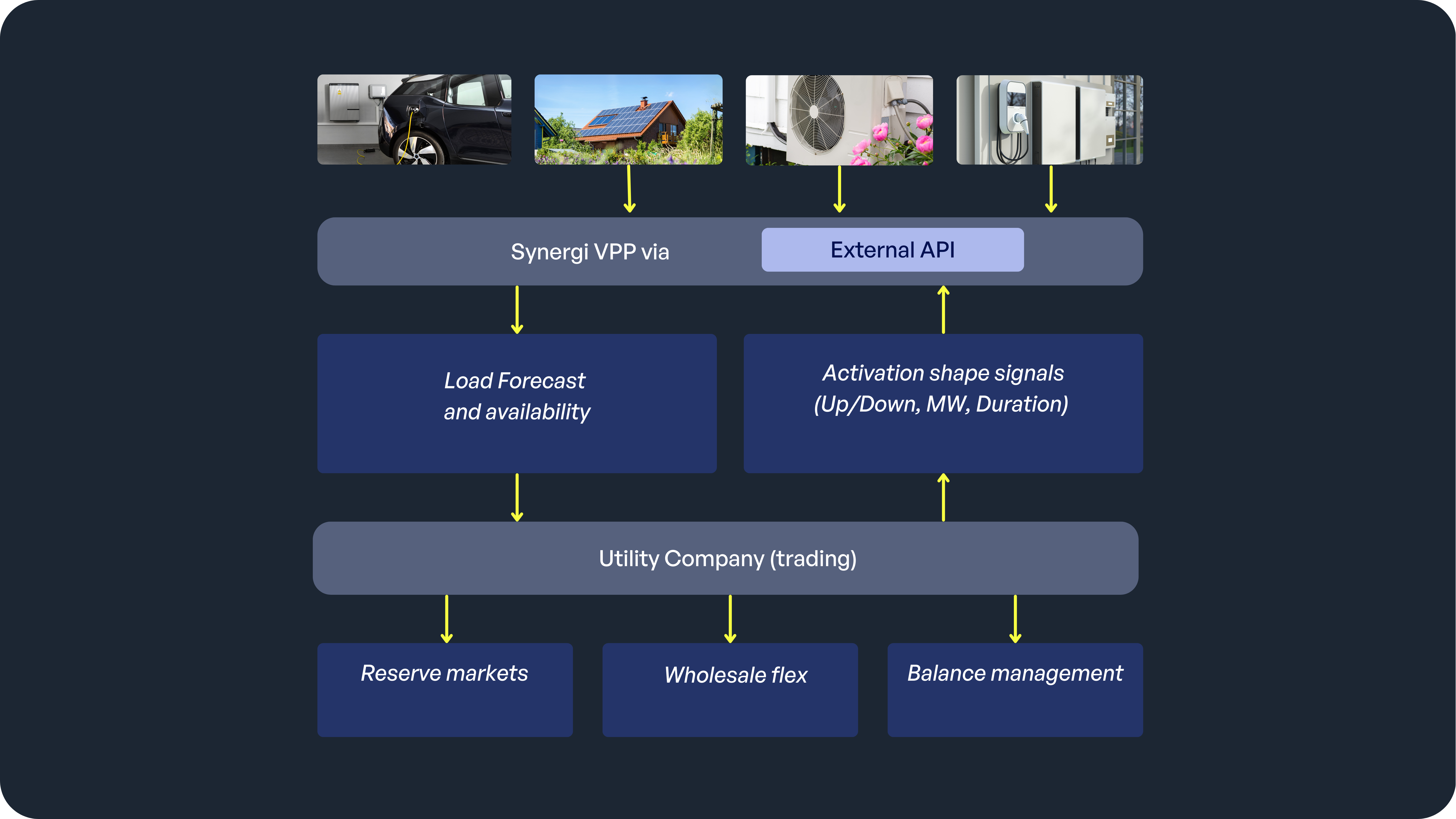
Heat pumps, water boilers, home batteries and solar inverters to follow – Synergi pioneers residential asset aggregation
EVs are just the starting point. Synergi is expanding its virtual power plant to include heat pumps, water boilers, solar, and batteries. Each new device class adds portfolio capacity without requiring separate control systems or customer interfaces. One platform, multiple assets, unified dispatch.
Since trading household flexibility remains new across European utilities, Synergi's end-to-end approach offers a clear advantage: it's 5x more cost-efficient than building in-house and virtually risk-free. You learn the ins and outs of activating these loads alongside a partner that provides ready-made tools for both your trading desk and your end-customers.
If you’d like to explore how Synergi’s VPP can help you maximise the flexibility of your customers’ connected assets and create measurable impact, leave us your details below:
Read our case studies
How Helen develops flexibility solutions for households with Synergi
How Virši piloted managed EV charging to shift household energy use and reduce imbalance costs
KSS Verkko enhances local flexibility using automated demand response solutions
How Aalto Energia is building a modern energy offering with plug-and-play digital tools


.png)
.png)
.png)
.png)

.png)
.png)


